

5 August 2026 · 7 min read
Great Masurian Lakes Trail - what should you know?
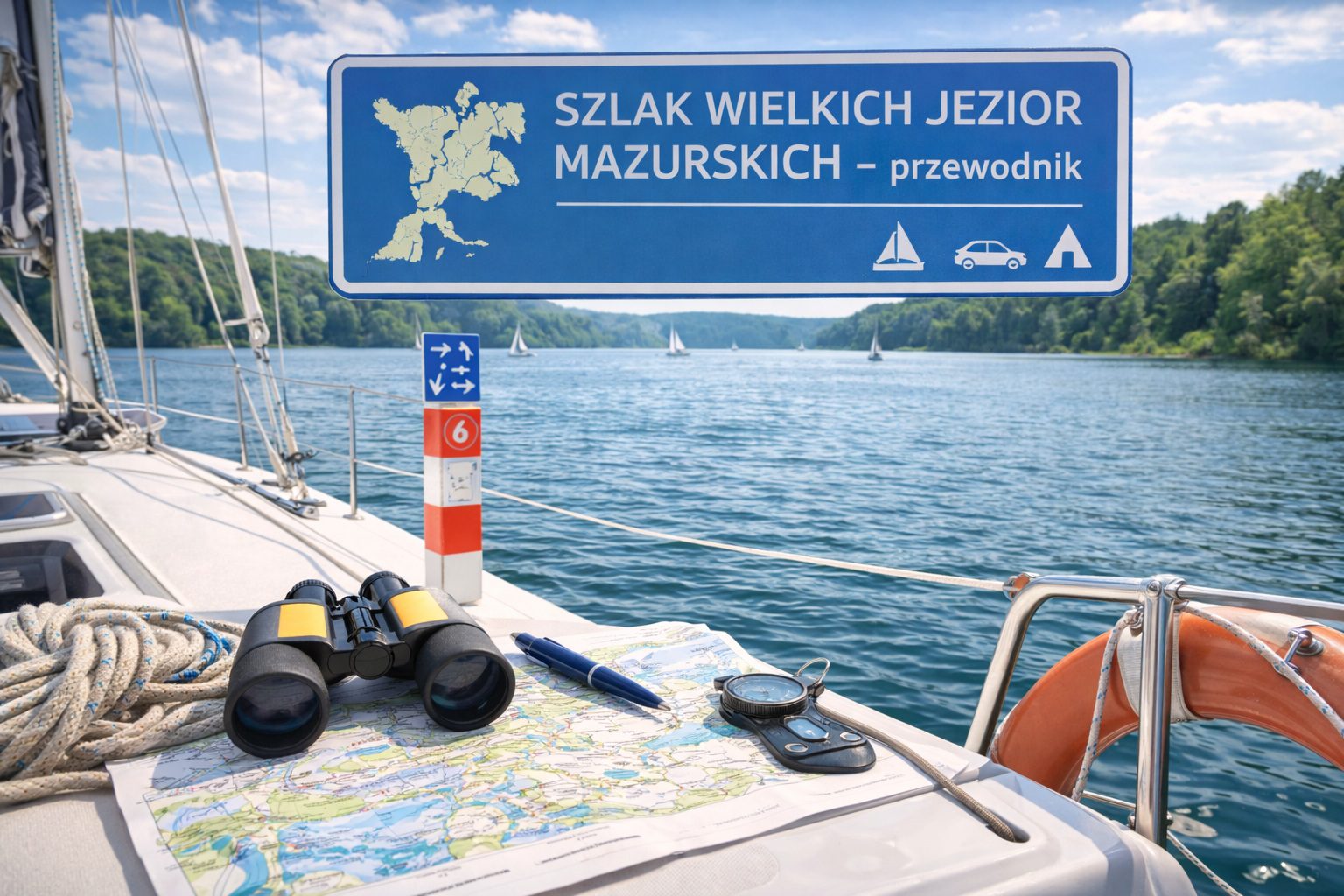
The Great Masurian Lakes Trail is a system of more than twenty lakes connected by canals, where you can sail for an entire week without repeating the same route. It is open to sailing yachts and motorboats, as well as larger passenger vessels operating on the inland waterways. It is one of the most extensive waterway systems in this part of Europe.
Our Jachty Mazury charter base is located in Giżycko, at Stanica Wodna Stranda harbour, almost at the centre of the trail. This gives crews leaving our marina a similar distance north towards Węgorzewo and south towards Mikołajki or Ruciane-Nida.
The route combines several things at once. It is a navigable network with a genuine engineering history, but it is also a tourist trail passing through towns that are hundreds of years old. For sailors, this means that a cruise along the trail is not only about wind and water, but also about stopping in places with stories of their own.
To explore the trail, we offer both sailing yachts charter, as well as motor yachts,, so you can match the type of boat to the part of the route your crew wants to discover in the most detail.
How was the navigable route connecting the Masurian lakes created?
The trail in its present form is the result of work carried out in the eighteenth century, rather than a natural arrangement of waterways. The lakes had existed for thousands of years, but connecting them into one navigable route required canals to be dug.
Before that happened, the lakes were used mainly for practical purposes. People travelled across them and transported goods, particularly timber and grain, while journeys between individual bodies of water continued over land. The first historically known users of these waters were the Galindians, a Baltic tribe who sailed here more than two thousand years ago. In the Middle Ages, they were followed by the Teutonic Knights.
The turning point came in the second half of the eighteenth century. At the initiative of people associated with the court of the King of Prussia, work began on a system that would make navigation between the lakes possible. Between 1765 and 1772, the Węgorzewski, Sztynorcki, Giżycki, Piękna Góra, Niegociński, Kula, Szymoński, Mioduński, Grunwaldzki, Tałcki and Nidzki canals were dug. In the nineteenth century, some of them were deepened, allowing larger vessels to use the route.
Work is also continuing on the concept of the so-called Masurian Loop, which would connect several smaller bodies of water and create an alternative route between Lakes Niegocin and Śniardwy. A feasibility study was completed in 2023, but the project remains at the planning stage. It shows that the development of the Masurian canal network is not yet a closed chapter.
Which lakes make up the Great Masurian Lakes region?
The main route and its branches include more than twenty lakes, but several of them define the character of the entire trail. Starting in the north, these include Mamry, Kisajno, Niegocin, Tałty, Bełdany, Mikołajskie, Śniardwy and Nidzkie.
The largest bodies of water along the route
- Mamry - a complex of several connected lakes with a combined area of more than 104 km², making it the second-largest body of water in Poland after Śniardwy. It contains 33 islands, most of them on Lake Kisajno.
- Śniardwy - Poland's largest lake, sometimes called the Sea of Masuria. Its bed contains glacial boulders that pose a genuine hazard to boats, so it calls for more caution than the other lakes along the trail.
- Niegocin - a lake exposed to winds from every direction, where waves can grow surprisingly large for inland waters. It lies directly beside Giżycko.
- Tałty - the deepest lake on the trail, with a long, narrow glacial shape and a length of more than 12 km. It forms part of the route connecting Ryn with Ruciane-Nida.
- Kisajno - one of the most beautiful lakes along the route, with an intricate shoreline and numerous islands protected as a nature reserve. The so-called Swan Trail runs through it.
- Bełdany - the section leading through the Pisz Forest to the Guzianka lock, popular for its scenery and busy with other boats during the season.
Towns and villages along the trail
The route passes through four main towns: Węgorzewo, Giżycko, Ryn and Mikołajki. Each has a different character and range of attractions, so it is worth deciding how much time your crew wants to spend ashore and how much on the water before choosing the order in which to visit them.
Węgorzewo lies on an island in the River Węgorapa and is a natural starting point for crews approaching from Lake Mamry. Giżycko, where our base is located, sits at the very heart of the trail between Lakes Niegocin and Kisajno. Ryn is a small town dominated by a Teutonic castle above Lake Ryńskie. Mikołajki is often called the sailing capital of Masuria because it has one of the largest marinas on the route.
Beyond Mikołajki, the trail divides. One branch leads south-west to Ruciane-Nida via Lake Bełdany and the Guzianka lock; the other runs south to Pisz across Lakes Śniardwy and Roś. Choosing between them is one of the most important decisions when planning a longer cruise.
How many kilometres long is the route through the Great Masurian Lakes?
The main axis of the trail, from Węgorzewo to Lake Nidzkie, is more than 100 kilometres long. At a relaxed sailing pace, with a different stop each day, this distance fits comfortably into a one-week charter departing from our harbour in Giżycko.
When you include the branches, such as the route to Pisz and the side bays worth exploring, the total length of navigable routes in Masuria exceeds 200 kilometres. If every variant and detour is counted, there may be as much as 330 kilometres of waterways. Covering all of that is a plan for almost two weeks, rather than a single week's holiday.
For crews with less time, a shorter version works well. A few days is enough to explore one section, for example the route from Giżycko to Mikołajki and back, without rushing but also without trying to reach every corner of the Great Masurian Lakes. The time you should allow depends on whether your priority is to travel as far as possible or to explore a few places at a gentler pace.
What is worth seeing while sailing the lake trail?
The Great Masurian Lakes Trail offers more than views from the deck. It also passes specific places that are worth going ashore to see. These are some that we regularly recommend to our guests.
- Boyen Fortress in Giżycko - a nineteenth-century fort built in the shape of an irregular polygon. It remained a military site until 1957 and is now open to visitors. It is close to our base, making it a good first or final stop on a cruise.
- The swing bridge over the Giżycki Canal - a historic structure dating from 1889. It swings sideways instead of lifting upwards, which is unusual for this type of bridge. Its ceremonial opening in May marks the start of the sailing season in Masuria.
- The Teutonic castle in Ryn - a fourteenth-century building overlooking Lake Ryńskie, now converted into a hotel. It is worth stopping for at least a few hours to see the town from the hill.
- Guzianka lock - a site with a history reaching back to the nineteenth century, where boats can overcome the difference in water level between Lakes Bełdany and Nidzkie in a matter of minutes. It is one of the key points on the route to Ruciane-Nida, although it can become crowded in the middle of the day.
- The islands of Lake Kisajno and the Swan Trail - a protected nature reserve with abundant water birds and a chance of seeing a white-tailed eagle. Approaching the islands themselves is prohibited, but the route beside them is one of the most picturesque on the entire trail.
How should you plan a cruise through the Great Masurian Lakes?
A well-planned cruise starts before you leave the harbour, not once you are already on the water. It is worth making a few decisions in advance so that you do not have to improvise during the week.
- Choose your direction and section of the route. Sailing north from Giżycko takes you to Lake Mamry and the Węgorzewo area; heading south leads through Mikołajki towards Ruciane-Nida or Pisz. It is rarely possible to do both in one week, so it is worth deciding which direction matters most.
- Match the type of boat to your crew. A larger sailing yacht, such as the boats in our fleet, requires a sailing licence, while sailing yachts with a hull length of up to 7.5 m may be operated without one. If nobody in the group has the relevant qualifications, a houseboat available through our no-license charter.
- offer can be a good alternative. A week is enough for the main axis of the trail, a few days for one section. You can check available dates and prices in our price list.
- Allow for locks and quiet zones in your daily schedule. The Guzianka lock can be busy in the middle of the day, and Lakes Nidzkie and Dobskie are quiet zones where engines must not be used. It is better to plan to pass through these sections early in the morning.
- Check the current map and weather forecast just before you set off. Warning masts with a yellow light visible within a radius of several kilometres have been placed along the trail; the frequency of the flashing indicates the level of danger on the water.
If you are only just planning your first route, also take a look at our charter guide – there we have gathered more tips on the booking process itself and on collecting the yacht. Whichever option you choose, the Great Masurian Lakes Trail offers enough space for every cruise to be different, even if you set off from the same harbour every year.
Read on
- Yacht safety in Masuria: the key rules The skipper bears full responsibility for the safety of the yacht and the whole crew and for compliance with navigation regulations. Whether you are interested in a charter without a licence or hold full qualifications for larger boats, every cruise on the Masurian lakes needs one person who has full control over what happens on board and on the water.
- What to pack for a sailing trip in Masuria: a practical guide Space on board during a sailing trip is limited. How should you plan your packing so you do not take either too much or too little? See what it really makes sense to have with you on a sailing trip in Masuria.
- Yacht charter in Masuria - the complete guide Chartering a yacht in Masuria is one of the best ways to spend a holiday close to nature, away from the crowds and at your own pace. At the same time, for many people — especially on their first cruise — it raises a lot of questions, uncertainty and worries: which yacht to choose, how much it really costs, what formalities are required and how to avoid common mistakes.
Picked your dates?
See which yachts are available, or give us a call.


 English (UK)
  Polski